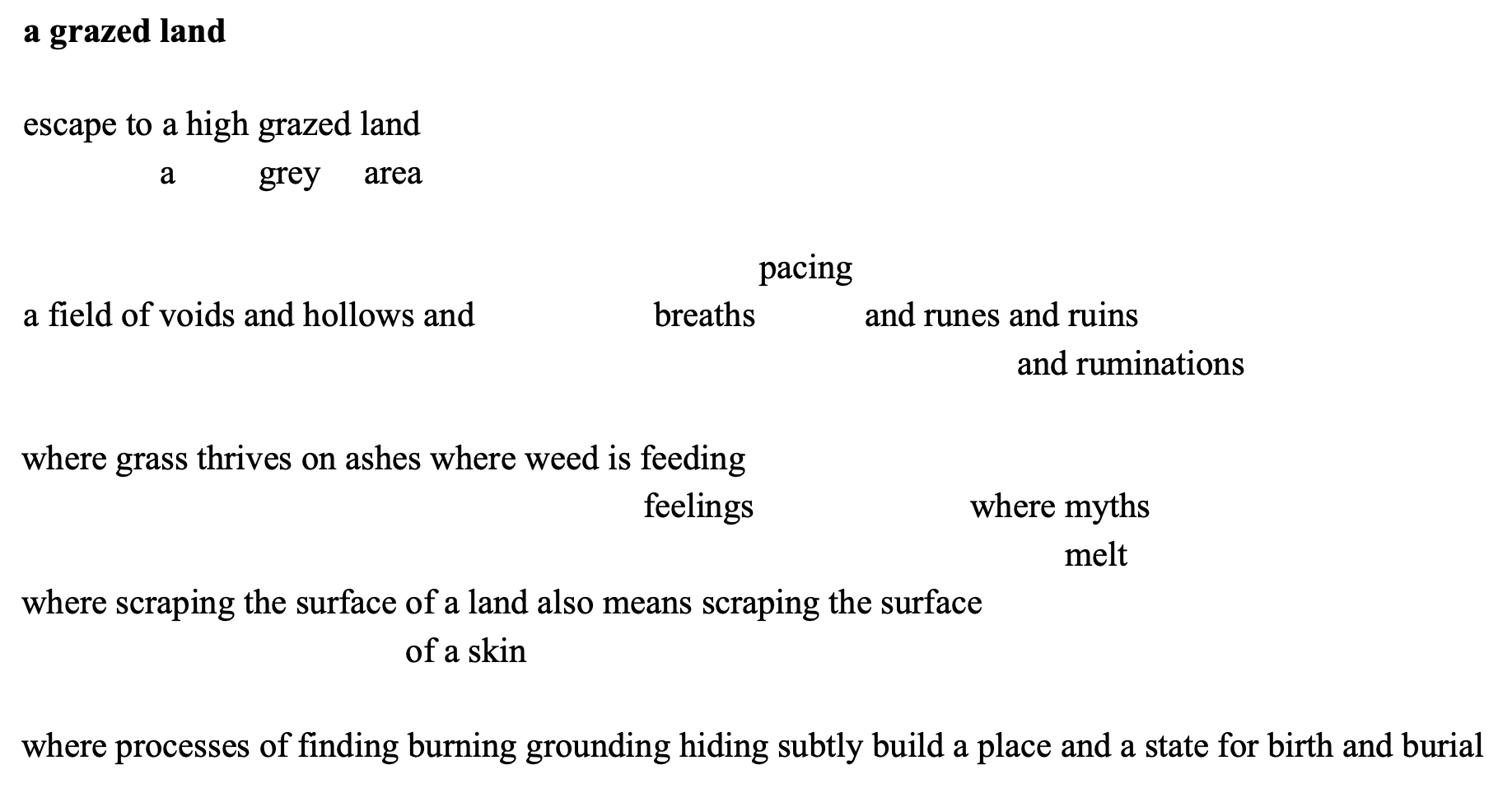
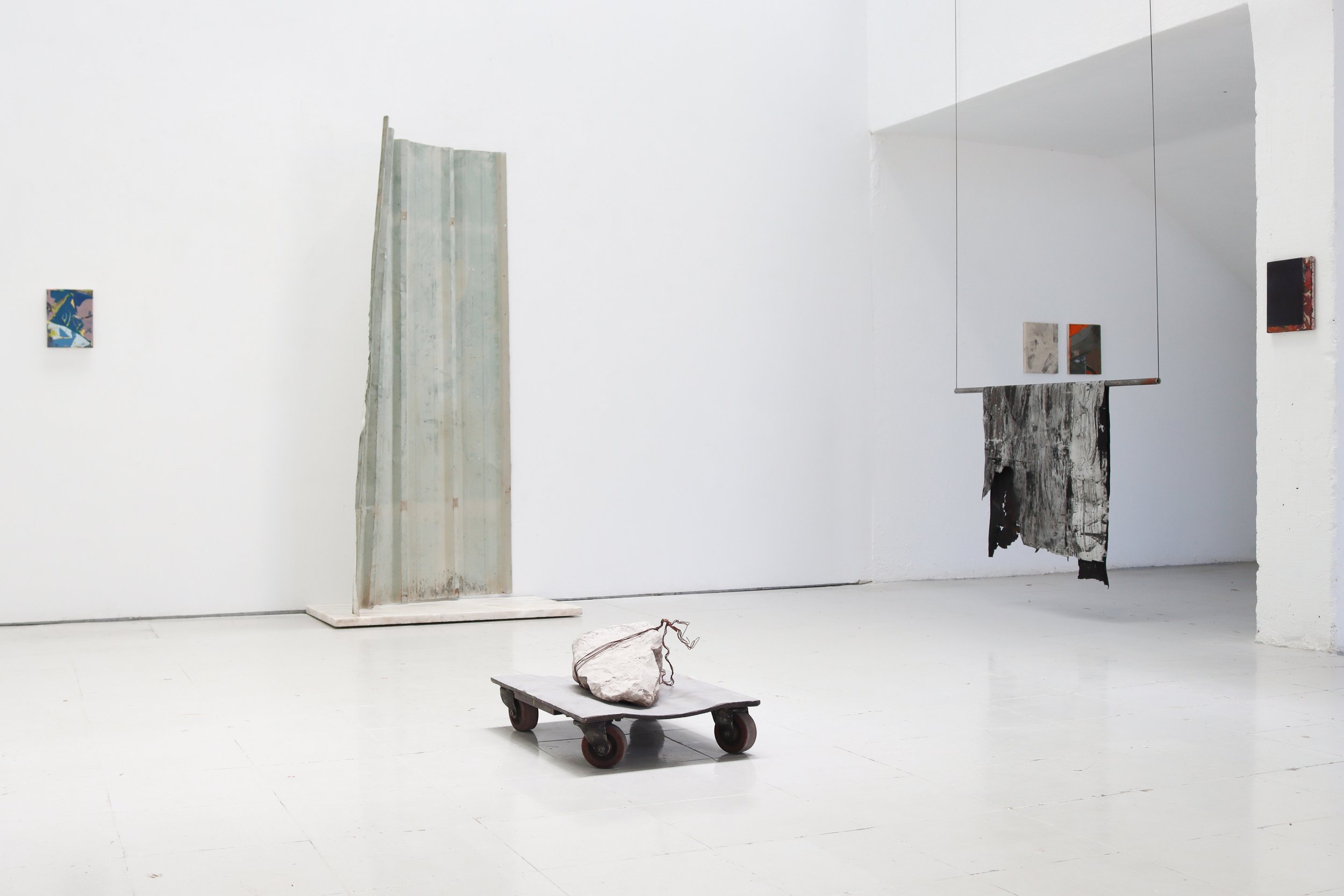
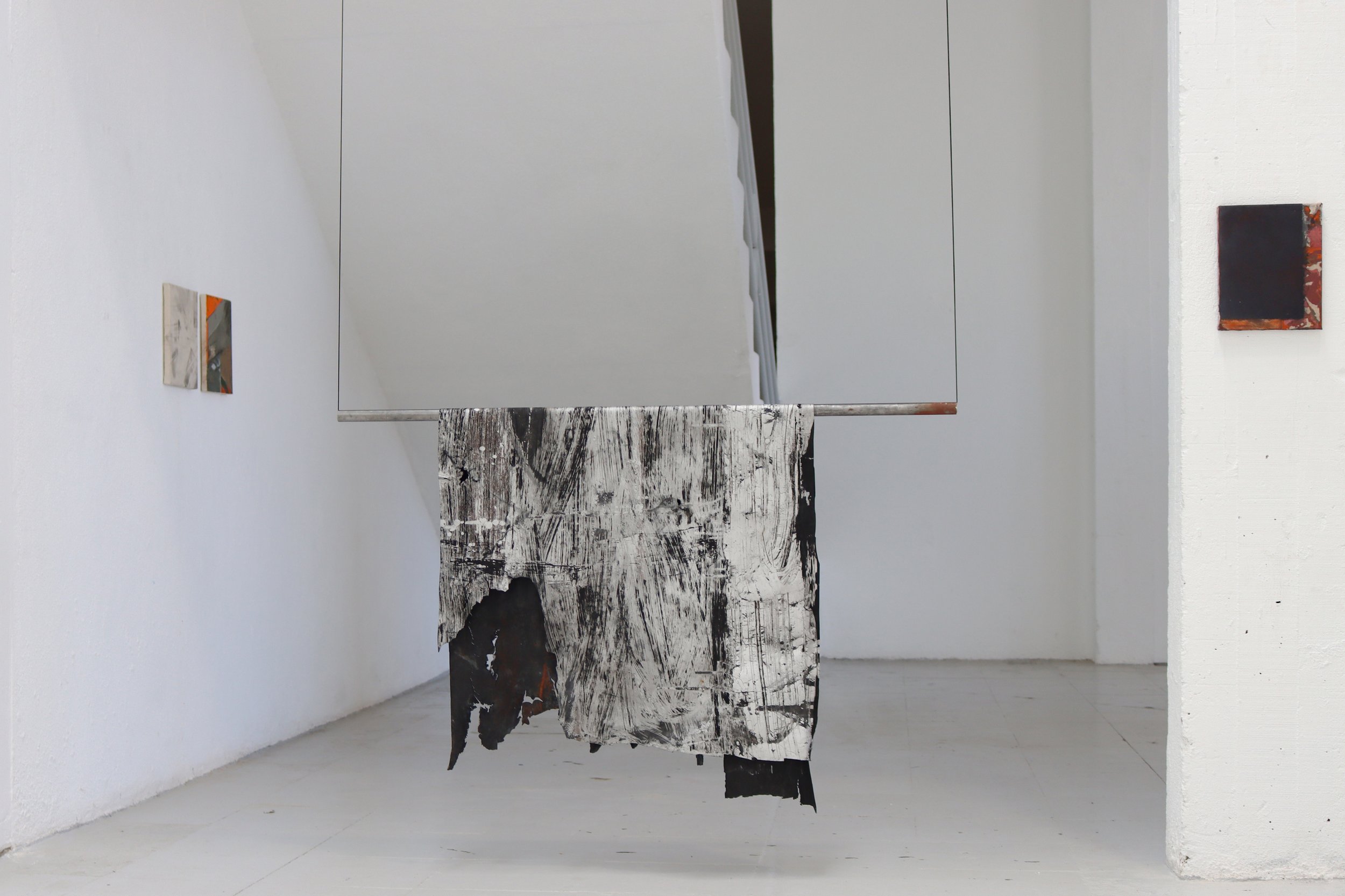
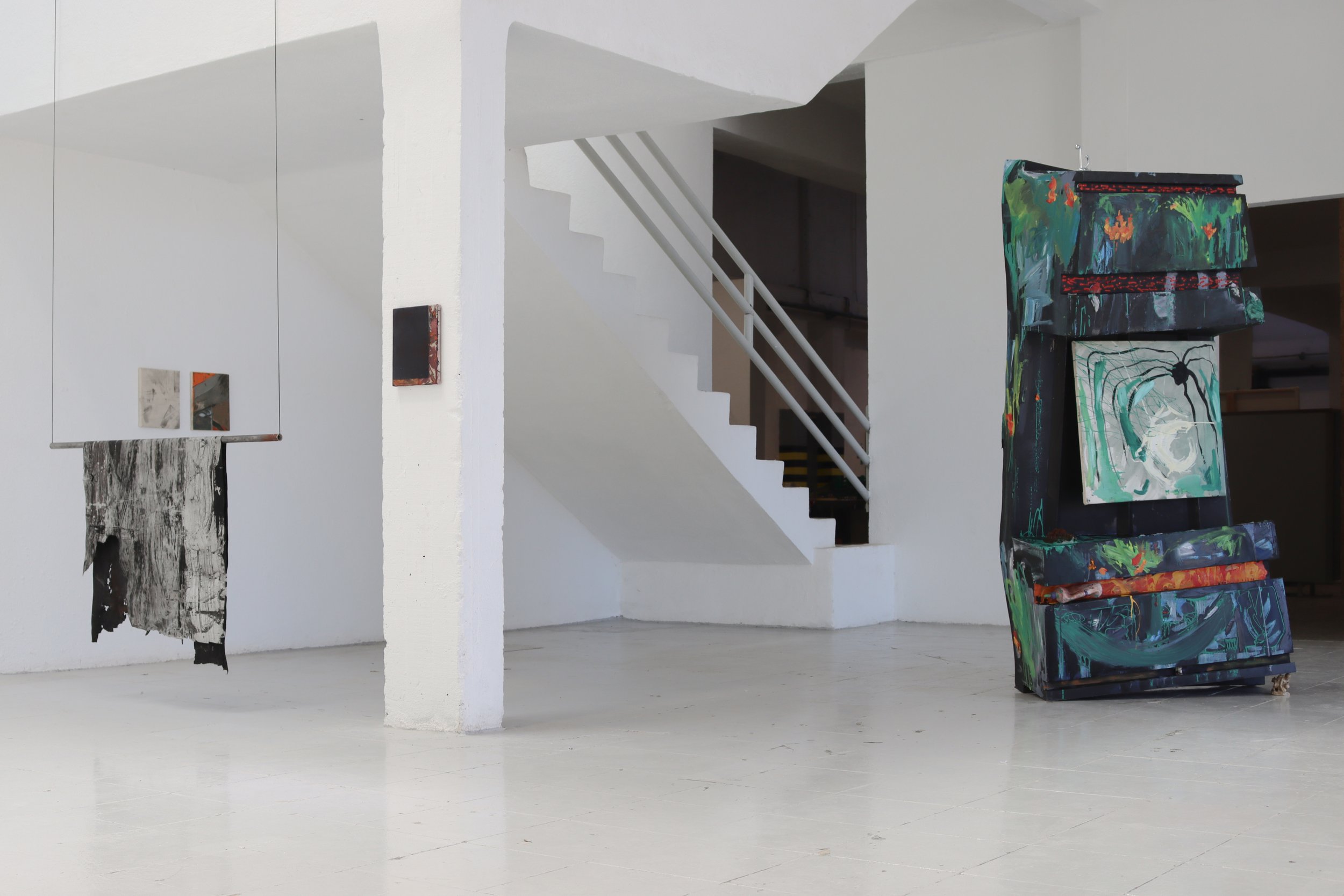
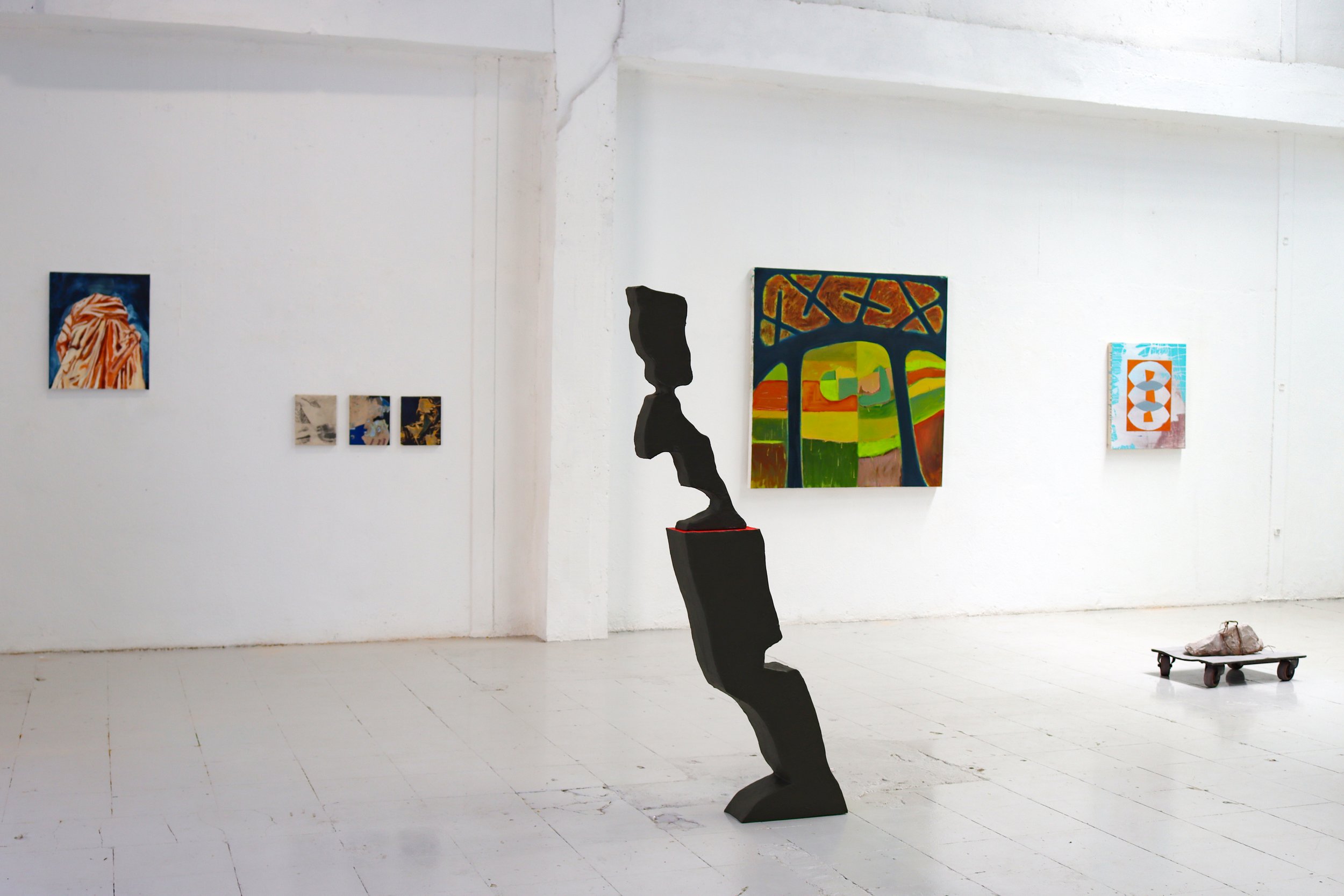
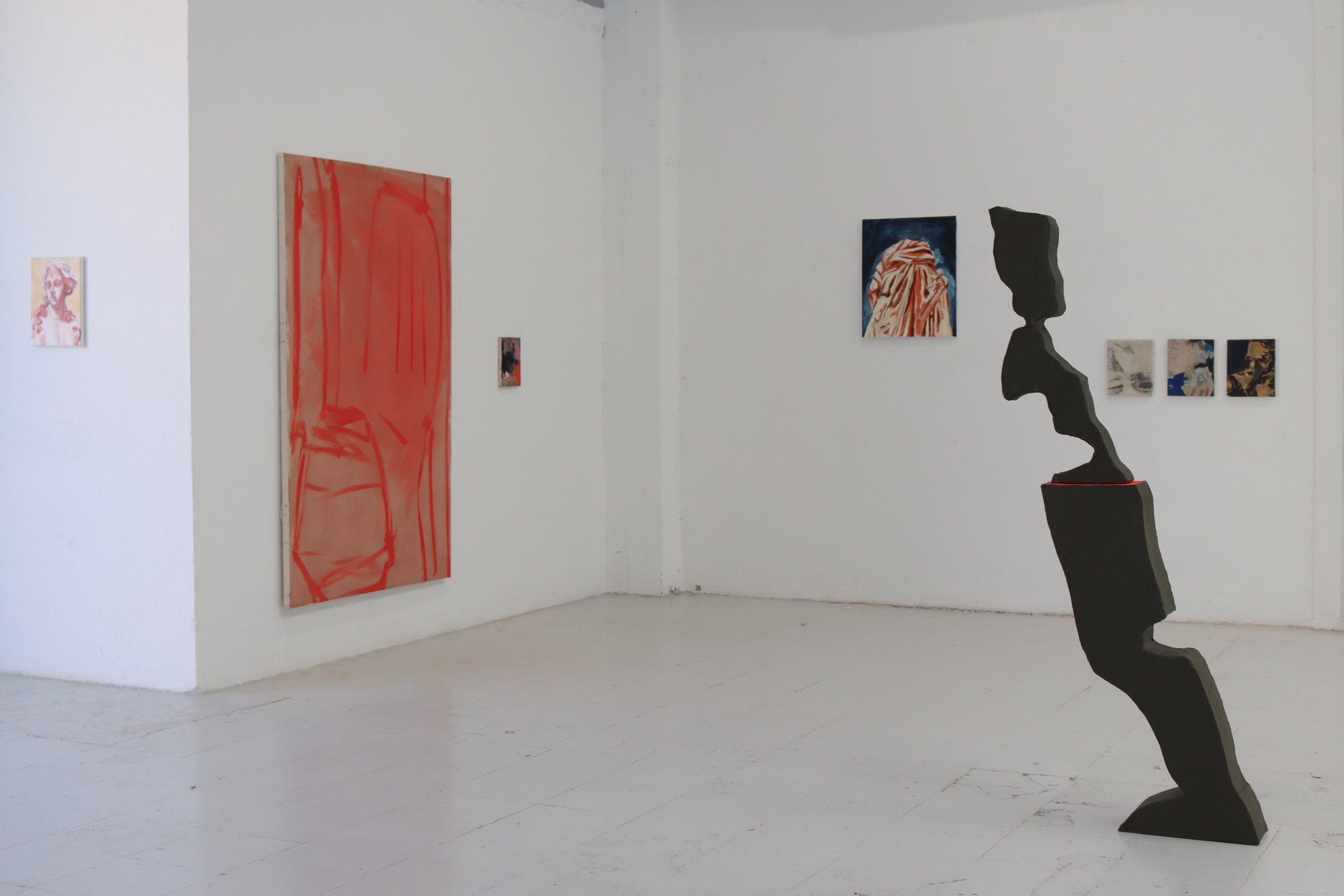
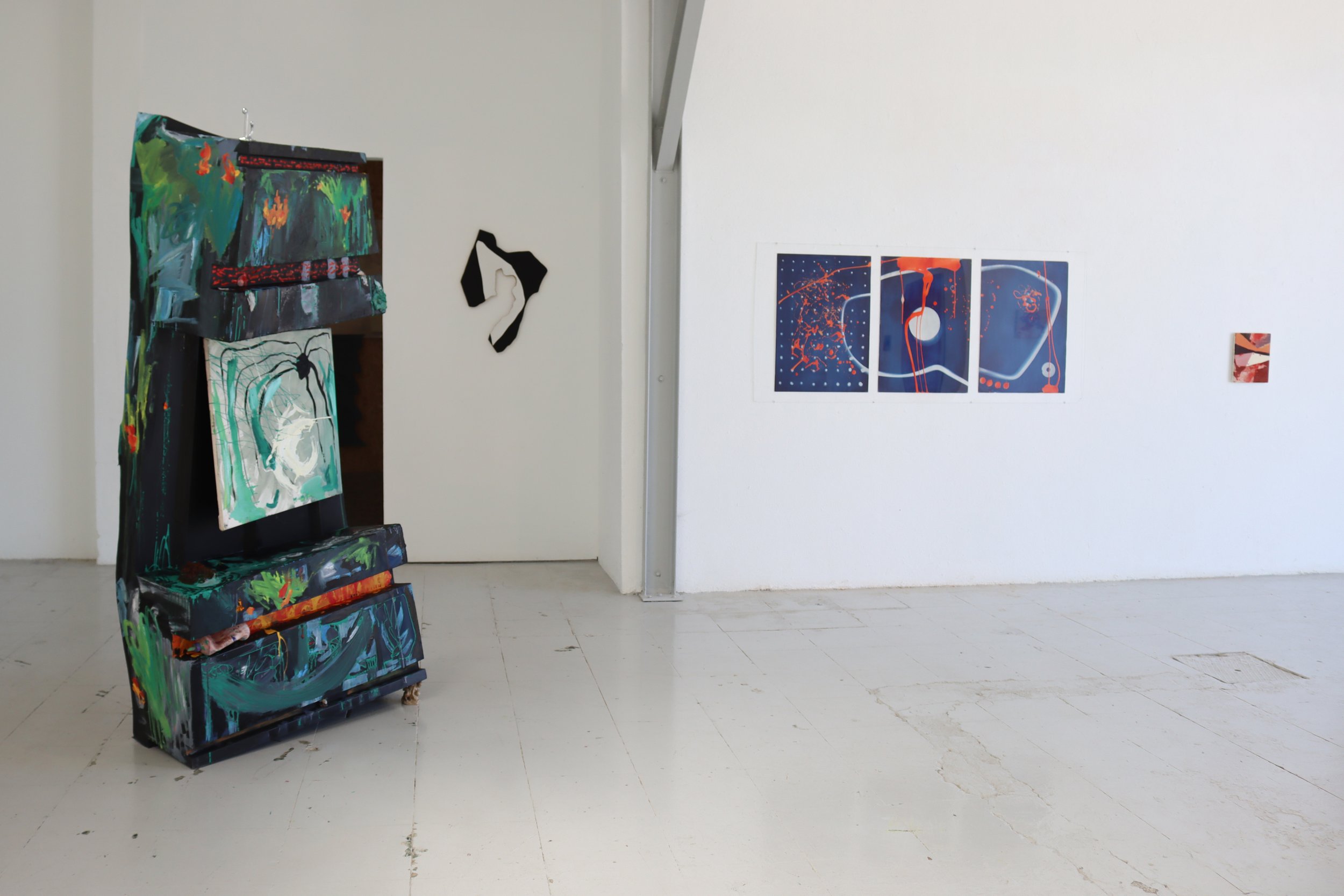
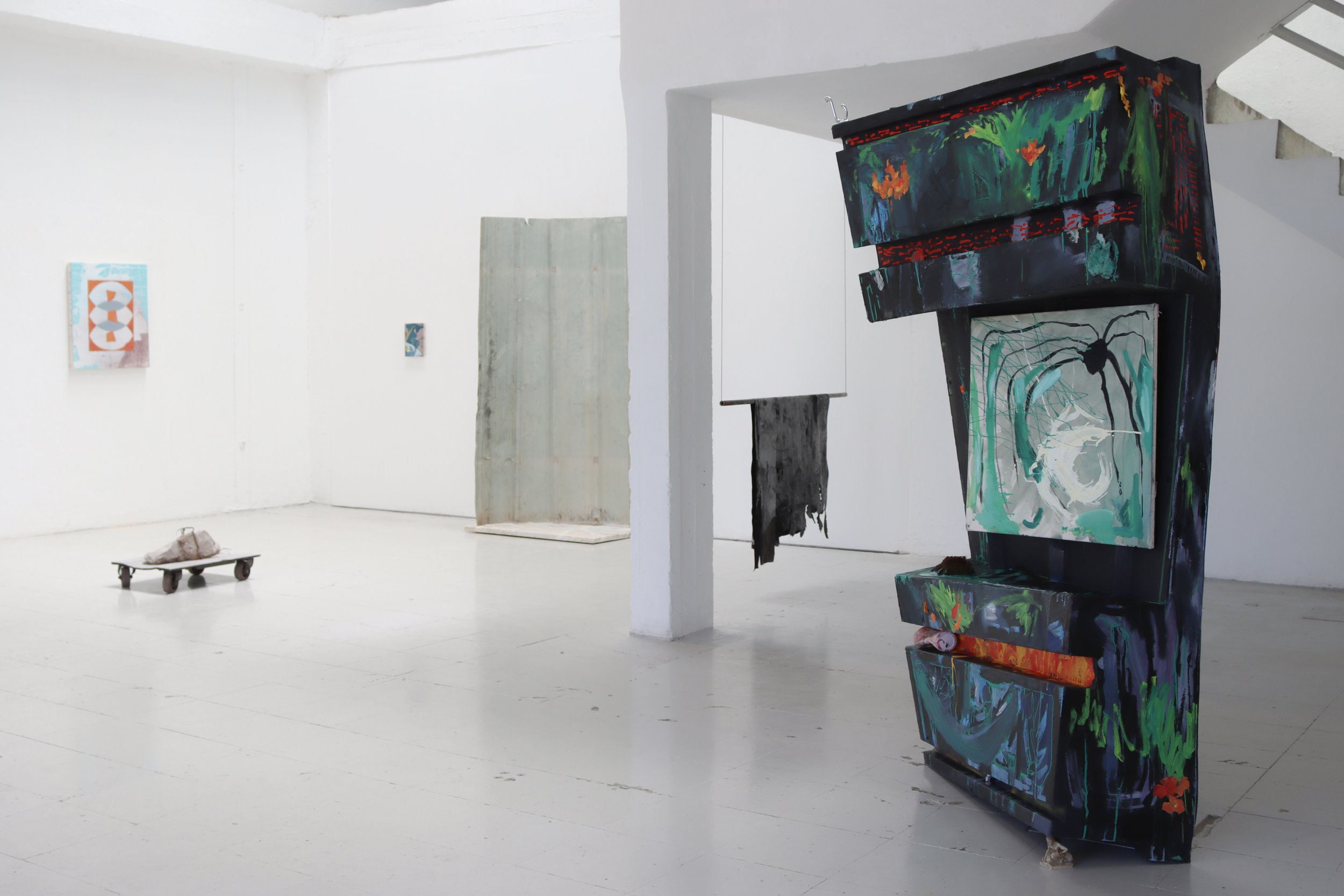
Tomb, like womb. Jonah Alexander's canvas sets the tone with its concurrently heavy and playful title and composition. Under an arch, an ambiguous figure lies down on the swathes of a diffracted landscape. Strolling still, as if caught in a stream of thoughts. We are drawn into a world of dreams and hallucinations of ever-changing shapes. Sebastien Pauwel’s work engages us in a search for pareidolia by playing with materials, volumes, cuts and shadows. Leftover #3 is rooted in the evocative power of neglected forms, whilst his sculpture Rui-To seems to defy the laws of balance as we go round the piece. Catie Dillon's graphic artworks also manipulate our perception. The presence of a repetitive almond shape, reminiscent of an eye, invokes the idea of vision and her layering recalls patterns of optical illusions as well as psychedelic apparitions. They evoke some kinds of cryptic oracles worthy of the Pythia in Ancient Greece. Susanne Lund Pangrazo’s statue Portal daydreams while we get lost in the folds of the marble cloth of her work Hidden. Her paintings, based on photographs taken during her wanderings in Lisbon, take us into a world on the edge of fantasy and reality. Her draperies echo Rosanna Lee’s metallic curtain. The artist gathered and nursed objects she found around: a barrier became a theatrical curtain floating over marble, a rubber sheet grew into a painting, and a knotted rock now peacefully sits on wheels. This ensemble of relics, titled Atlas, evokes both a mapping of the earth and Greek mythology. Here, the world seems calm, balanced, cared for. Atlas and Sisyphus may rest. It is then the figure of Hades that supports Jesús Crespo's Carcass, a flaming arcade embodying the idea of metamorphoses. It is on this striking structure found in the streets of Barreiro that he deploys his emotions, transcending the limits of paintings. Vivid bursts of colors can also be witnessed in Clara McSweeney’s Remnants, reflecting both on painting and photography. To compose this ensemble of three cyanotypes, she took the imprints of circular objects found in Barreiro and created free curved movements around them as if to reveal their aura. She therefore manages to poise the suspense between immobile prints and motion. Anouk Van Zwieten’s work too is mediating contrasts – ones of belonging and displacement. After collecting shapes and shadows observed on the city’s walls, she obsessively translates them onto the canvas. Her monochrome red painting Heads is made of one bold raw layer welcoming imperfections and allowing the viewers to witness one intention and build their own interpretations. Finally, Cecilia Sebastian de Erice's small formats of ground traces and oil paint, scattered in the space, create a form of horizon. Made in response to the close-by abandoned paint factory, they act as windows into the surrounding landscape, as echoes of present works and perhaps as hints of future realizations.